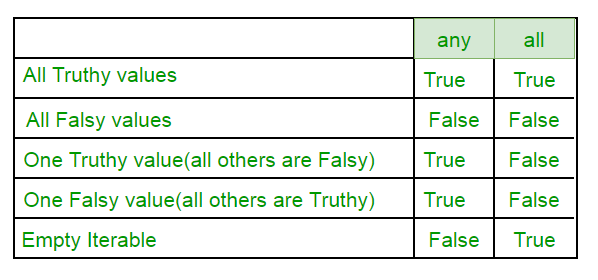
any() is a built-in function in Python 3 (and Python 2 since version 2.5), to check if any of the items of an iterable is True . It takes one argument, iterable . This table below is helpful in understanding all and any iterable.
 ## Argument
iterable
The iterable argument is the collection whose entries are to be checked. It can typically be a list , str , dict , tuple etc., even a file object .
Return Value
The return value is a Boolean. It returns ‘False’ if and only if all entries of iterable are False , or the iterable is empty. This function essentially performs a Boolean OR operation over all elements.
If even one of them is True , it returns True .
The any() operation is equivalent to (internally, may not be implemented exactly like this)
def any(iterable):
    for element in iterable:
        if element:
            return True
    return False
It stops the execution as soon as the result is known.
Code Sample
print(any([])) #=> False
print(any({})) #=> False
print(any([None])) #=> False
print(any(['', {}, 0])) #=> False
print(any([6, 7])) #=> True
print(any([6, 7, None])) #=> True
print(any([0, 6, 7])) #=> True
print(any([9, 8, [1, 2]])) #=> True
print(any([None, []])) #=> False
print(any([9, False, [1, 2]])) #=> True
